Thursday, October 28, 2010

Sinbad is so bad it should be a sin.

Producer Jeffrey Katzenberg is a bit of a polarizing figure in animation. Some people credit him for the resurgence of Disney's feature film animation in the early 1990s, others condemn him for helping kill the medium in the early 2000s. Personally, I think Katzenberg is a consummate business man who would rather exploit tried-and-true formulas than tell a good story. In other words I think that Katzenberg's better movies succeeded in spite of him, not because of him. I mention this because Sinbad: Legend of the Seven Seas has all the formulaic earmarks of a Katzenberg production. From the contrived romance to the forced humor, Sinbad offered up nothing new for audiences, just the same old animated schtick Katzenberg had come to rely on at Dreamworks. When the film failed Katz declared that traditional animation was dead and that audiences were only interested in CGI films like Shrek. Of course the sad truth isn't that audiences stopped caring about traditional animation, they just stopped caring about derivative animation like Sinbad.

I would like to just take a minute and go on a bit of a rant about CGI versus traditional animation. Released in 2003 Sinbad: Legend of the Seven Seas garnered a mostly tepid response, both critically and finically. Following the failure of Fox's Titan A.E. (2000) and Disney's Atlantis (2001), Sinbad proved to be the "last straw" of sorts for traditional animation. Unfortunately many people mistook the death of this "Katzenberger" style of traditional animation as the death of the medium itself. While the signal being sent to Hollywood was "we want different stories, like Pixar", all they heard was "we want movies that look like Pixar", thus traditional animation was all but abandoned. Exacerbating the situation was the fact that CGI films were getting a finical boost from their choice of animation method (how else do you explain the success of Ice Age?). This is because average moviegoers mistook the "new and shiny" look of CGI for fresh storytelling, a misconception that did not last long. Once the novelty of CGI wore off studios started seeing revenue decline. Why? That's easy, because people got tired of seeing generic looking, crappy stories in CG, just like they got tired of seeing generic looking, crappy stories in traditional animation a decade prior. Good stories are the key to sustained success, if you give people good stories consistently (Pixar) you will be rewarded with loyalty, this goes for both CGI and traditionally animated films. If you give people bad stories however (Shrek 3), you'll see a huge dip in box office returns down the road (Shrek 4), regardless of the medium. So stop trying to trick people into watching your movies with the latest fad and focus on telling good stories with a unique vision, otherwise we're just going to repeat this cycle again with 3D (actually it's already happening so get ready for the inevitable backlash).

Alright, putting that incoherent rant aside, it's time to move on. The story of Sinbad goes ... well you know what? I don't feel like recounting the story of Sinbad so here are the basics. Sinbad is an infamous pirate who used to be best friends with a prince named Proteus. Proteus is engaged to a princess named Marina (arranged marriage), but Sinbad also loves Marina (oh crap). Our bad guy (or gal I guess) is Eris, Goddess of Chaos. Eris wants the "Book of Peace" - an ancient artifact housed in Proteus's kingdom - so she hires Sinbad to steal it. Sinbad changes his mind however and Eris is forced to step in and steal the book herself, framing Sinbad in the process. Once arrested Sinbad tries to explain that he was setup by Eris, but ultimately he is given the death sentence because no one believes him, no one except Proteus that is. Unable to standby and let his friend die, Proteus exercises his right of substitution and takes Sinbad’s punishment upon himself, including the forthcoming execution. The only way to save Proteus is for Sinbad to find and return the Book of Peace, a task he only has ten days to accomplish. Luckily Marina decides to come along and help Sinbad so that she can save her future husband. Sound good? Well it shouldn't because this story is about as interesting as a paint-by-numbers stop sign.

It's hard to know where to begin when discussing the problems with Sinbad's writing. I think I'll start with the characters comprising its Arthurian love triangle. Proteus is a ridiculously abused character. If you merged King Arthur and Duckie from Pretty in Pink, you would get Proteus. In fact, for the rest of this review I will be referring to Proteus as Arthur-Duckie. Arthur-Duckie is the consummate good guy, the one who always does the right thing, never takes anything or anyone for granted and believes in others, even when they don't believe in themselves. While these selfless attributes may seem admirable, the film abuses them in an absurdly cruel way by having the two people closest to Arthur-Duckie walk all over him like a doormat. Don't worry though, he's really understanding about it. The bride-to-be of Arthur-Duckie is Princess Marina. Marina is about a shallow character as I've ever seen in animation. Serving as the films Guinevere, Marina suffers from both cliche and superficial characterization. You see Marina has reservations about settling down and marrying the future king Arthur-Duckie, part of her wants to live a life of adventure on the open seas rather than deal with the daily burdens of being a queen. Unfortunately this message of "follow your heart" comes off as a childish flight of fantasy, the immature dreams of a spoiled rich girl who knows nothing about responsibility. This is a problem because Marina doesn't end up exhibiting any redeeming qualities, instead she just appears selfish and disloyal, hardly a heroine worth rooting for. Then there's our Lancelot, Sinbad. Sinbad and Arthur-Duckie used to be best friends, but ten years ago Sinbad got a look at Arthur-Duckie's betrothed, Marina, and fell instantly in love. Not wanting to suffer the heartache of seeing the two wed - or worse get in the way - Sinbad runs away and takes up a life of piracy. Despite his thieving ways Sinbad is still a good guy at heart though, he just tries to act tough and hide it so people won't notice. Too bad he doesn't have a good woman around to help him open up about his feelings, maybe then he could become the man he was always meant to be (gag). It doesn't take a geniuses to figure out where things go from there - heck this is about a contrived a romance as you'll ever see - but while this predictable love affair is certainly A problem for the film, it's not THE problem. The real problem with Sinbad's love triangle is that the whole film collapses around its hideous execution.

The reason that Sinbad's romance causes so much trouble is that the rest of the story (you know, that whole "Book of Peace" thing) exists solely as a vehicle for it to take place in. In other words the success of the films plot depends entirely on the execution of Sinbad and Mirana's love affair, it's the stories linchpin (the catastrophically defective linchpin). Besides the problems I've already listed (Marina's shallow motivations and Sinbad's cliched "bad boy with a heart of gold" persona) the biggest source of romantic failure in this film is banter. Remember how great those fights between Bruce Willis and Cybill Shepherd were on "Moon Lighting"? When they would stand toe-to-toe in the middle of the room yelling at one another then storm off and slam the doors to their respective offices, that was great. Well Sinbad tries to use that same sexual tension in its narrative, emphasis on the word "tries". Time and time again Sinbad ineptly dons the role of "obnoxious" and "chauvinistic" pirate determined to get the princesses goat, all the while Marina plays up her irritating "sassy princess" persona complete with the "how dare you" attitude seen in about a bazillion other movies. It's awful. I'm talking groan out loud - you have got to be kidding me - awful. Glaringly scripted and completely unnatural, just about all of the exchanges between Sinbad and Marina play out like a bad sitcom, all that's missing is a laugh track. In the end these pathetic attempts at bickering start a snowball affect beginning with the failure of the banter, then the failure of the romance, and ultimately the failure of the movie. It may seem like I'm putting too much emphasis on the relationship of these two characters, but as I said earlier the "Book of Peace" is just a MacGuffin, its only purpose is to further Sinbad and Marina's romance. When that keystone breaks the whole thing comes crumbling down.

The rest of the films writing is so-so. Some of the exchanges are decent, I even laughed a couple times at the forced humor, but on a whole the film comes across as desperate. The writers just look like they're trying too hard, throwing joke after joke at us hoping that something will stick, not cool. Even Eris's motivational twist at the end of the film feels illogical and counterintuitive. Why would you concoct such an over-elaborate plot to throw Syracuse (Arthur-Duckie's kingdom) into chaos if you can send the whole world into chaos using the "Book of Peace"? That's like a poor person winning the mega-millions lottery, but only upgrading their trailer to a double wide. Anyway, when you get right down to it there's very little to salvage from this story, structurally speaking the pacing is solid, and the plot - for all its faults - is coherent, everything else is an absolute mess.

Visually I would describe Sinbad with three seemingly random words: beautiful, typical and awful. Let's start with the beautiful. The traditional animation in Sinbad is fantastic. From the fluid movement, to the excellent choreography, to the stunning backgrounds (especially Syracuse), Sinbad features expertly crafted 2D animation. Easily the best part of the movie, the only complaint I had regarding the traditional animation was that it looked like a typical Dreamworks film. What I mean by that is Dreamworks used the same basic look for all of its traditionally animated features, especially in regards to the characters. Having just re-watched "The Road to El Dorado" I was able to easily spot similarities in not only the character designs (which were obvious), but in the mannerisms and expressions of the characters as well. Though still beautiful, these visually repetitive renditions made Sinbad look a little inbred, something that rarely occurred at Disney. Still, this is a pretty picky complaint, overall Sinbad's hand drawn animation looked excellent and was the one bright spot in an otherwise ugly film.

So if the 2D animation is beautiful, yet typical, what would the visually awful portion of Sinbad be? Not surprisingly it's the CGI. Some people like to refer to Dreamworks traditional films as "tradigital". This is because the studio used a significant amount of digital imagery in its animated movies, even in scenes where it wasn't necessary. Though this is not a practice I normally approve of, I have to admit that Dreamworks did a good job of merging CGI and hand drawn animation in the past ... until Sinbad that is. Sinbad: Legend of the Seven Seas features some of the ugliest integration of CGI and traditional animation I've ever seen in feature films, the worst offender being a giant squid at the start of the movie. Early in the film Arthur-Duckie is transporting the "Book of Peace" to Syracuse via ship when he is boarded by Sinbad who's - of course - trying to steal the book away from his former friend. This awkward reunion gets cut short by Eris when she sends a giant squid to get the book for herself, thus forcing Arthur-Duckie and Sinbad to work together to fight the beast. From the moment that giant squid smashes his tentacle through the hull of that ship, you can tell this scene is going to be an absolute wreck.

Completely different in style, there was no way for this CGI monstrosity to blend into its traditionally animated surroundings, worse it doesn't even look like the computer animator tried. Part of me wonders if Katzenberg just told the directors to get it done and not worry about how it all turned out. Yes, that's some pretty harsh conjecture, but that's how bad this thing looks. The various monsters encountered later in the film do shape up a little better - though still not good - but it really doesn't matter because the movie gives such a bad impression at the start, you can't get over it. Several things about this irk me: 1) This movie was released in 2003, the art of integrating CGI and cell animation was not a new thing at this time 2) Dreamworks could have done a better job, heck they already did a better job in previous films like the aforementioned "Road to El Dorado" 3) Katzenberg looks like he just gave up on traditional animation by half-assing this aspect of the film, almost as if he wanted to sabotage Sinbad so that he could put an end to traditional animation. Am I being a little bitter here? Probably, but watching studios crap all over the admirable efforts of traditional animators with egregious CGI and formulaic storytelling pushes my buttons every time.

The voice acting from Sinbad neither offended, nor impressed me. Like most animated films of the time, Sinbad features a star studded cast including Brad Pitt (Sinbad), Catherine Zeta Jones (Marina) and Michelle Phifer (Eris). While each of these actors does a respectable job with their role, I didn't feel like anything unique or special was being brought to the table either. The hardest performances to judge are Pitt and Zeta Jones. Given how bad the movies romance is I'm tempted to include both of these actors in my - admittedly - harsh appraisal of the film. Yet when I really think about it I don't feel like they were the problem. Sure, Pitt and Zeta Jones could have had better chemistry, but truth be told their delivery of the films banter wasn't all that bad, it's the material that stunk. I think that if the writing had been better the characters would have worked fine with the voices as is, conversely I don't think that any actor alive could have kept this script from falling flat. Overall the voice acting and music from Sinbad do what they're supposed to, neither really stands out but they don't contribute to the films problems either.

Obviously I'm not recommending Sinbad: Legend of the Seven Seas. Though the traditional animation is good, even its light cannot escape the black hole of suck that is this film. Yes, I'm sure that children (and very simple minded adults) would find Sinbad an enjoyable ride, but this kind of pandering tripe represents everything that was wrong with traditionally animated feature films during the early 2000s. If you're looking for good, family friendly, animation that isn't rendered on a computer, then I recommend: The Iron Giant, Beauty and the Beast, The Lion King, Mulan, Aladdin, Tarzan, anything directed by Hayao Miyazaki, and of course the classic Disney films. Heck I'll even recommend Dreamworks "Price of Egypt" and "The Road to El Dorado", just don't bother with Sinbad, it's better left forgotten.

Saturday, October 16, 2010

My 25 favorite animated feature films

Making lists has become a very popular thing to do these days, so I guess it's only natural that I'm finally putting together my own list of favorite animated feature films.

Before we begin I want to just make a couple of declarations, clarifications and caveats. First off, this list will only feature traditionally animated films (or at least movies that are mostly traditional), so no Pixar. I do this because (I feel) the look of traditional animation and CGI animation is so different that the experiences need to be judged with separate criteria, the same goes for stop motion animation. Additionally, this list is strictly MY favorites. This is not a list of "best" animated films, or most influential or successful, it's just a list of movies I love.

So with no further ado, here are my 25 favorite animated feature films.

25. The Simpsons Movie
For close to a decade the Simpsons was - by far - the best primetime animated sitcom in history. As the years passed, however, the show became so stale and repetitive that people began questioning whether americas favorite dysfunctional family was relevant - or even funny - anymore. This atmosphere of skepticism was only enhanced by the announcement that a Simpsons movie was finally going to hit theaters in 2007. Could Homer and company recapture the magic that made them a world wide phenomenon, or would they simply hack out a pathetic cash grab and put the final nail in the proverbial coffin of this once great franchise? Well, much to my relief The Simpsons Movie turned out to be a fantastic return to form, one that reminded me exactly why I loved these characters to begin with. I won't get into any plot details, but the thing that made this story work so well was the writers understanding of the Simpson family. Whether it's Homer's selfishness, or Bart's desperate pleas for attention through delinquency, or Lisa's environmental causes (not to mention her girlish desire for romance), or Marge's constant forgiveness, this movie captures all the visceral personality quirks of the Simpsons perfectly and enjoyably (heck, even Maggie gets her chance to shine).

24. Secret of Kells
This movie would have ranked higher on my list had the ending been as exciting and magical as the rest of the film. Instead it felt very rushed and un-empowered (to me anyways). Regardless, the Secret of Kells is a wonderful tale set in the ninth century, rich with Irish folklore. It's about a young boy named Brendan whose life ambition is to become a master illuminator, but to do so he must disobey his uncle - Abbot Cellach - who expects Brendan to follow in his footsteps and complete a giant wall to protect the Abbey of Kells from Vikings. This conflict is further enhanced when Brother Aidan arrives in Kells and takes Brendan under his wing as an apprentice.

23. Wonder Woman
Of all the action-adventure DTVs that have come out over the last 15 or so years, Wonder Woman is by far the best. Not only does this film have excellent animation (especially for a DTV), amazing action and a great story; it handles the tough subject of female empowerment in the most honest way I've ever seen. Directed by the fantastic Lauren Montgomery, Wonder Woman is a layered and intelligent DTV that remains the gold standard of the genre.


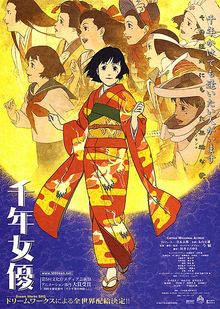
22. Millennium Actress
Directed by the late Satoshi Kon, Millennium Actress is a gorgeously animated movie that tells the life story of fictional actress Chiyoko Fujiwara by interweaving Chiyoko's journey to reunite with a long lost love into the various movie roles she played throughout her career. A beautifully poignant tale, Millennium Actress is a perfect example of how versatile a storytelling medium animation can be in the right hands.

21. Triplets of Belleville
French director Sylvain Chomet's 2003 movie Triplets of Belleville is a wonderfully offbeat film. Animated in a very retro - pen and ink - fashion this movie has tons of style and very little dialog. The story revolves around a tiny French woman named Madame Souza who must raise her grandson after his parents die. Unable to initially shake the boy from his depression, Madame Souza finally finds the key to getting Champion (that's her grandson's name) back on his feet, cycling. Years later, Champion is now a professional bicyclist competing in the Tour de France. Champion is unable to finish the race, however, and finds himself kidnapped by New York gangsters and taken to America. Determined to get her grandson back, Madame Souza travels to America herself and befriends the Triplets of Belleville, a group of three sisters who were once popular 1930s music hall singers. Together this mismatched band of rescuers set out to save Champion. Despite being a wonderful film, I cannot help but be disappointed with the way Triplets of Belleville horribly stereotyped Americans as fat, glutenous slobs. Yes, there is a sad truth to this stereotype (the US consumes egregious amounts of natural resources, our eating habits are terrible and obesity is one of our most serious problems) it ultimately feels mean spirited and resentful. Though it's meant as a caricature, I'm pretty sure Sylvain would be equally offended by a film depicting French people as unwashed, cowardly, arrogant, wine drinking, cheese eating frogs. That little rant aside, I love this film's artistic vision and charming characters.

20. Ponyo
Hayao Miyazaki's 2009 film Ponyo was almost perfect. Very loosely based on Hans Christian Andersen's "The Little Mermaid" story, Ponyo features a young - quasi-human - goldfish that falls in love with a boy named Sōsuke. Despite the disapproval of her father (who is some kind of scientist/magician), Ponyo eventually turns herself human and escapes to the surface world. Fantastically conceived and beautifully animated, the only flaw I found with Ponyo was that the final stage of Ponyo and Sōsuke's "trial" missed the mark. I don't want to give anything away, but I really wanted to see Sōsuke's loyalty tested by Ponyo's father, instead it all just played out like a big misunderstanding. Overall, this is a great movie though, and one that can be enjoyed by people of all ages.

19. The Secret of Nimh
This movie comes from a time (1982) when feature film animation was a little "darker" than it is now. Even Disney films like the Fox and the Hound and The Rescuers were far more moody than what audiences have come to expect. That said, this darker tone is perfectly suited for the subject matter of this Don Bluth masterpiece. Though set in our world, the story of the Secret of Nimh features anthropomorphic mice who live on a farm. One such mouse, Mrs. Brisby, is trying to move herself and her children from their current home - which is in the middle of a field - before plowing begins that spring. Unfortunately her youngest child has fallen ill and cannot leave the home, so Mrs. Brisby must seek the assistance of super intelligent rats led by the mysterious and mystical Nicodemus. Featuring amazing animation - and world building - the Secret of Nimh is Don Bluth's best directorial work.

18. Bambi
Do I really need to explain why this film is on my list? I thought not. Sufficed to say, Bambi is one of the most visually groundbreaking animated films ever created. Funny, tragic, inspiring an honest, this is one of Walt's greatest accomplishments.

17. Lady and the Tramp
Much like Bambi, I see no need for a plot synopsis with Lady and the Tramp. Gorgeous animation, idyllic backgrounds and a timeless story (not to mention a little risque), Lady and the Tramp literally could not be any better than what it is.

16. Mulan
While it'll never be as popular - or influential - as other Disney films, Mulan is still an excellent movie. The stories heroine is Mulan, a Chinese girl who pretends to be a man so that she can serve the military in her fathers place (her father has become too frail to serve himself). Featuring excellent music, attractively simple character design and lots of laughs (courtesy of Eddie Murphy), Mulan not only delivers in the entertainment department, it effectively drives home the great message that women are just as capable as men.

15. Paprika
Another amazing Satoshi Kon film. In this 2006 psychological thriller, a new device called the "DC mini" has been invented allowing people to insert themselves into dreams. Developed as a new form of psychotherapy, one of the Doctors working on the project has begun using the device to help people under the persona "Paprika". Before the DC Mini is approved by the government, however, three prototypes are stolen and mysterious deaths begin to occur. Upon investigation, Paprika is drawn further and further into a twisted dream world where reality and dreams begin to become one. Using all the tricks he developed in previous projects, I feel that Paprika is Satoshi Kon's best work. If you liked Inception you'll probably dig Paprika.

14. Tarzan
This movie is a visual feast. Basically you get some of the best traditional animation ever, seamless CGI integration (seriously, checkout those branch surfing scenes) and wonderful music. All wrapped together by a tight story that can actually pull at the heart strings when it wants. Like Mulan, this film may never be a classic, but it certainly is amazing.

13. Aladdin
Despite being a great film, there's actually some negativity one must acknowledge when talking about Aladdin. For one, people have accused the film of "borrowing" heavily in both look and feel from The Thief and the Cobbler, a movie that was plagued by years of on again, off again production. Secondly, Aladdin contains a great deal of pop-culture humor, something that many critics (and fans) dislike because it goes for "cheap" laughs and dates the film (seriously Robin Williams, my kids don't even know who Arsenio Hall is). Finally, very few people ever mention this, but the whole genie portion of Aladdin plays out very closely to another Disney film released only two years prior, Duck Tales Treasure of the Lost Lamp (give it a watch sometime and you'll see what I mean). All that said, I still believe that Aladdin is one impressive animated feature. Great story, great songs, great animation and great characters make this movie one of most beloved - and well rounded - Disney films ever made.

12. Ghost in the Shell
Though made in 1995, Ghost in the Shell is still an amazingly relevant piece of science fiction noir. Set in the year 2029, our primary protagonist is the cyborg officer Major Kusanagi, a member of the special police task force Section 9. While investigating the world renowned hacker "Puppet Master" Kusanagi begins to ponder her own existence as an artificial being,and soon discovers that the Puppet Master may hold the answer to her philosophical dilemma. While an excellent story with some unexpected twists, the thing that really sets Ghost in the Shell apart is its amazing visuals. Groundbreaking animation, insanely detailed backgrounds and some of the best action choreography ever put on film make Ghost in the Shell a definitive anime movie.

11. Peter Pan
It's hard for me to say exactly why I like this film so much. It isn't any one or two specific things I suppose ... it's everything. I love the look, the story, the voice acting, the pacing, the music and all the stuff in-between. Additionally, this is the last Disney film to feature all of Disney's Nine Old Men as directing animators, so in some ways it's the end of an era as well. Based on the J. M. Barrie story "Peter Pan, or The Boy Who Wouldn't Grow Up", Peter Pan is just great execution of a great concept, one that I can watch over and over again.

10. Sleeping Beauty
This film is just an amazing piece of art. Every time I watch Sleeping Beauty I'm blown away by the film's color styling and elaborate backgrounds. Artist Eyvind Earle not only designed all the fantastic settings of this movie, he painted the majority of them himself! Besides its visual prowess, Sleeping Beauty also has one of the best villains ever in Maleficent, and a prince that actually does something besides marry the princess (unlike those lazy princes from Snow White and Cinderella). Granted, it's not the most amazing story you'll ever see, but whatever shortcomings Sleeping Beauty may have are easily overcome by its unmatched artistry.

9. Castle in the Sky
Originally titled Laputa: Castle in the Sky, this movie may not be as highly praised as other Miyazaki films, but it's still an amazing piece of storytelling and one of my favorite animated features. The story of Laputa involves two youngsters named Sheeta and Pazu. After a somewhat unorthodox first meeting, these two heroes band together to uncover the location of Laputa, a castle that literally floats in the sky. To do this they must endure military agents, sky pirates and a giant robot capable of unbelievable amounts of destruction. As always the visuals in this Miyazaki film are brilliant (especially for a film from 1986) and the characters both charming and endearing. Simply put, this is adventure storytelling at its best.

8. Nausicaa and the Valley of the Wind
Another entry courtesy of Hayao Miyazaki (and my list isn't even done yet). Nausicaa may not be the first film Miyazaki directed, but it certainly is his breakout film. Released in 1984 and written by Miyazaki himself, Nausicaa and the Valley of the Wind is set in a post apocalyptic future where toxic jungles now consume much of the planet's surface making it difficult for humans to survive. Our heroine is Nausicaa, a young princess who must find a way for people to coexist with the environment before the rash actions of others lead to the total annihilation of mankind. Though obviously environmental in origins, the story of Nausicaa is the kind that gets its message across without sounding like some PSA (I'm looking at you Fern Gully). Thought provoking and in many ways ahead of its time, Nausicca and the Valley of the Wind is a beautiful film with substance.

7. The Lion King
It's not the most original story, but what the Lion King lacks in originality it more than makes up for with execution. What blows me away the most about this film is the emotional impact you get from the characters performances. Whether it's the look in Mufasa's eyes when Scar betrays him, or the heart wrenching attempts by Simba to wake up his father, the Lion King gives you goosebumps time and time again. It doesn't hurt that the animation and music are some of the best ever by Disney either.

6. Batman Mask of the Phantasm
Outside of the medium of print, Batman Mask of the Phantasm is the quintessential Batman story. A fantastically clever plot (loosely based on Batman Year Two I think) with a brilliant twist, Mask of the Phantasm tells the story of a young Bruce Wayne unsure of his decision to fight crime after he falls in love, and a modern day Batman struggling to catch a killer with ties to that past. Compared to many of the other films on this list, the animation found in Batman is only average (I believe it was supposed to be a DTV but got a theatrical release once higher-ups saw how good it was). That said the climax of this film does sport some awesome action and impressive visuals. Honestly, I love this movie so much it should probably be illegal.

5. Akira
Where Hayao Miyazaki's films transcend the genre of anime, Katsuhiro Otomo's "Akira" defines it. Released in 1988 and based on Otomo's hit manga of the same name, Akira is - arguably - the most important piece of anime ever produced. Set in the futuristic city of Neo-Tokyo in the year 2019, Akira revolves around two friends named Kaneda and Testuo. Like other delinquent youths, these two orphans fight on motorbikes with other gangs in the streets of Neo-Tokyo. During one of these battles Testuo collides with an unusual looking child who has blue skin and psychic abilities. The result of this encounter is that Testuo gains near godlike powers. Powers that bring out the worst in Testuo and drive him insane. Torn between the desire to save his friend and the responsibility he feels to stop him, Kaneda finds himself fighting a battle that may decide the fate of all Neo-Tokyo. For me to say the animation in this movie looks "amazing" or "beautiful" is an understatement. Akria is - quite simply - one of the most technically impressive films in the history of traditional animation. Backgrounds are unbelievable, the biker fight scene from the start of the movie is mind blowing, Testuo's first flight, the battle of Kaneda and Testuo, the chase in the sewers ... words just can't describe the sheer level of awesome achieved in these scenes. It's been over two decades since Akira set the bar for anime, to date no one has been able to raise it.

4. Spirited Away
Winner of the 2001 best animated picture Oscar, Spirited Away is - in my opinion - Hayao Miyazaki's most charming film. When ten-year-old Chihiro and her parents set out to move to a new town they encounter an abandoned theme park in the middle of nowhere. While Chihiro explores the rundown park her parents begin gorging themselves on food from one of the local vendor stands. As night descends, Chihiro returns to find both her mother and father transformed into pigs and spirits wandering the streets. Now trapped in this bizarre world, Chihiro must go to work at the local bathhouse while trying to figure out a way to save her parents. As always, Miyazaki creates a wonderful world full of rich characters and beautiful visuals. This is easily the most recognizable Studio Ghibli film here in the US, and its success opened the door for all of Miyazaki's other films to be released here.

3. Beauty and the Beast
The first ever animated film to be nominated for the Best Picture Oscar, Beauty and the Beast is Disney magic at its best. Though it features an astounding assortment of songs, phenomenal animation and great romance (this from a guy who isn't a romantic), the thing I love most about this movie is its characterization. Seeing the Beast change from a spoiled, angry child into man capable of sacrifice and compassion (I love that last scene with Gaston) is one of the best character evolutions in the history of film (not just animation). Hands down my favorite animated Disney feature.

2. Princess Mononoke
If I had to describe this film in a single word it would be "epic". Epic animation, epic story, epic music ... epic everything. Directed by master filmmaker Hayao Miyazaki, Princess Mononoke is one of the most intelligent and thought provoking stories you'll find in animation (or film in general). The plot centers around Ashitaka, the last prince of the Emishi. While protecting his village from a giant boar spirit turned demon, Ashitaka's arm becomes infected with a cursed mark that will spread throughout his body and eventually kill him. Upon discovering that the boar's madness was caused by an iron bullet, the young prince sets out on a journey to the west to discover the weapon's origin. Like Nausicaa and the Valley of the Wind before it, Princess Mononoke's plot is rooted heavily in environmentalism. Unlike Captain Planet and Fern Gully, however, Princess Mononoke doesn't present a black-and-white view of the subject. Instead of using the cliche "Man cut down trees, bad. Noble savage and nature, good" Miyazaki carefully constructs a story where there are no villains, just people with different agendas. Sadly, these agendas can be very destructive, but the people behind them are often quite noble and well intentioned. This is the brilliance of Princess Mononoke, the film doesn't try and preach at its audience or pass judgment on its subject, directors like James Cameron could learn a lot from this film (his movie Avatar is ungodly preachy). Epic in scope and perfect in execution, the Princess Mononoke is my favorite Hayao Miyazaki film.

1. The Iron Giant
In 1999 this movie was a flop. Released behind a poor marketing campaign, The Iron Giant came and went from theaters so fast that it might as well have never existed. I was working as the projectionist at a local second run theater at the time and stayed late to watch the movie after building it on Thursday night. I was mildly interested in the story since it appeared to have science fiction origins, but my expectations were pretty low. About half way in I realized I was watching a masterpiece. Directed by two time Oscar winner Brad Bird (Incredibles, Ratatouille), The Iron Giant is a film that shows no fear when breaking from convention. Where other animation directors simply aped the Disney formula in the late 90s, Bird chose to tell a story that had no musical numbers, no princesses, no cute sidekicks and no romance. Instead of adapting some overly familiar fairy tale Bird based his film on a 1968 novel titled “The Iron Man” by Ted Hughes. Set in the year 1957 during the height of Mccarthyism and the Red Scare, The Iron Giant tells the story of Hogarth, a young boy who befriends a giant robot from outer space while trying to hide it from government agent Mansley. An amazingly touching film that captures a time in American history where fear dictated far too many of our actions (something we should remember these days), the Iron Giant is – simply put - Powerful. From a visual perspective, Brad Bird took no shortcuts while making this film either. Featuring a beautiful color pallet and some of the best CGI and traditional animation integration ever, this movie looks fantastic. Though it was not a finical success, The Iron Giant did go on to receive near universal critical praise and is now considered a modern classic. Without a doubt my favorite animated film.

Monday, October 4, 2010

Batman/Superman Apocalypse - I've seen worse ... barely

When I first heard that DC was going to do another DTV of a Jeph Loeb Batman/Superman story, I was less than thrilled. Actually, that's a little generous, I was straight up pissed. With so many great comic stories yet to be adapted into DTV format, I felt frustrated with the current crop of modern story selections. Couple that with my familiarity of the hideously bad source material for Batman/Superman Apocalypse, and I just couldn't see how the movie would be any good. Now having watched the film, I've got to admit ... it's not horrible. It's still bad mind you, but nowhere near as bad as it's predecessor Batman/Superman Public Enemies, and certainly better than I expected.

The story of Batman/Superman Apocalypse revolves around Kara, Superman's long lost cousin and future Supergirl. Picking up after the destruction of the kryptonite asteroid in "Public Enemies", Kara crash lands in Gotham city and quickly finds herself possessed by powers she cannot control. Once subdued Superman takes the young girl under his wing and attempts to integrate her into everyday life. Batman on the other hand, sees Kara as a potential threat and makes no attempt to disguise his concerns. Meanwhile, Darkseid (ruler of the planet Apokolips) learns of Kara's arrival on earth and decides to kidnap her and brainwash the young Kryptonian into leading his honor guard (the Furies). Wonder Woman also gets involved thanks to the prophetic dreams of Harbinger, and brings Kara to Themyscira to keep her safe and train her to control her powers. Anyway, Kara eventually gets captured by Darkseid and taken to Apokolips where Batman, Superman, Wonder Woman and Big Barda must finally try and rescue her. If this plot sounds paper thin, that's because it is.

In terms of writing, the story of Batman/Superman Apocalypse has numerous problems. Let's start with the dropped plot point concerning Kara's identity. During the first act of the film Batman is clearly unconvinced that Kara is who she claims to be. This skepticism is reinforced - for both the Dark Knight and the audience - when Krypto (that's right, the Superdog) takes a very hostile attitude towards Kara in the Fortress of Solitude. Then ... nothing. The whole subplot about trusting Kara just disappears into an orgy of fights between Amazons, Doomsday clones, Furies and Darkseid. Don't get me wrong the action is great, but you can't just abandon plot points like this and think your story will work.

Another issue I had concerned the portrayal of Kara as a typical teenager during the shopping spree montage. Once Superman takes Kara to Metropolis for the first time (keep in mind this is her first exposure to human society outside of her crash landing) she immediately starts buying up trendy clothes like some character from a Bratz commercial. This makes absolutely no sense. Kara is an alien from Krypton, a society nothing like earth. Wouldn't she be more confused and lost than anything? Hell, there are people from our own planet freaked out by western civilization, I have a hard time believing Kara would gorge herself on it like some fanboy with a bag of Doritos. Ultimately, this depiction of Kara feels like some middle aged mans cliched view of teenage girls and the story is cheapened because of it.

Though this shallow depiction of Kara early in the film does subside later in the story, she never really finds any depth. An attempt is made to show her as sad upon losing a friend, but the film never develops the relationship enough for us to emphasize with her. Her reluctance to embrace her powers and use them for good gets downplayed throughout most of the movie, so when she decides to become Supergirl it really doesn't have any weight. Lastly, the bitterness and anger Kara feels toward the people who keep telling her what's best for her gets completely negated by the Darkseid brainwashing. Basically, every shot this film takes at making Kara three dimensional misfires horribly and the character suffers as a result.

Then there's the overall story macguffin. Why does Darkseid want Kara to lead his honor guard so bad? I know he hates Superman - and it would be fun to take away the only living blood relative he has - but somehow that just doesn't feel meaty enough. The whole thing just seems ... random. Like someone threw together a story with as many "hot chicks" and "heavyweight fights" as possible so the person illustrating the story could cut loose. Oh wait, that's exactly what happened. You see, Michael Turner was a very popular artist back in the early 2000s (Sadly he lost his battle with cancer in 2008. He was only 37 years old.), but he had never worked for any of the mainstream comic companies like Marvel and DC. When DC finally snagged Turner to do a short stint on Batman/Superman in 2004, they decided to make the most of the opportunity and gave the penciller a story he could really sink his teeth into. Unfortunately this turned out to be the comic book equivalent of Transformer Revenge of the Fallen, all flash and no substance. In the end we were left with some pretty pictures and little else.

So, with its numerous flaws - including a story that's about as substantial as a Kleenex tissue - why is it I didn't absolutely hate this film? Well there are a several reasons actually. For one, the humor works rather well. I chuckled numerous times throughout the story, and even laughed once or twice (and they weren't laughs of disgust!). Secondly, the action is amazing. Yes, I know it sounds hypocritical of me to both praise and damn this movie for having so much action; but while I would have liked to see a story with more substance, I can't help but admire the amazing fight choreography Warner Premiere is doing these days. Lastly, the biggest reason I didn't hate this movie was because the writer who adapted the story had the common sense to remove the egregious des deux machina Jeph Loeb wrote into the source material. Originally, the final showdown with Darkseid began with Kara being "killed" by Darkseid's Omega Beams. This led to a bunch of angry yelling about how much "spunk" the girl had, as well as some woefully deep reminiscing by Superman on the life of Kara. Then it turns out she's alive! How you ask? Well as luck would have it, Superman, Batman and the rest of Kara's new friends knew exactly what Darkseid was going to do and faked her death by teleporting her away at the last second! Brilliant ... no wait, I meant to say lame. This is exactly the kind of writing that has turned Jeph Loeb from one of the best writers in comics into one of the worst. Thankfully, the screen writer for this film saw how incredibly stupid and unnecessary this plot device was and removed it entirely from the story (now if they could've only done the same thing with that egregious Batman/Superman robot from Public Enemies, I might have actually liked the film a little). Anyway, the story for Batman/Superman Apocalypse is definitely not good. Knowing how bad it could have been however, I actually found myself giving the screenwriter a little leeway. Not exactly resounding praise I know, but considering the source material I decided to cut the movie a break.

As one would expect, the animation in Batman/Superman Apocalypse is impressive (or at least the traditional stuff was, the CGI was pretty weak). Based on the excellent art of Michael Turner, I thought the overall look of this film was solid, albeit not great (Turner's art is far too "sketchy" to adapt accurately in animation). I was definitely impressed with the way the animators captured the eyes in particular. Turner had a very distinct way of drawing women's eyes and this movie captures it perfectly. One criticism I did have however, was with the exploitative depiction of women in the film (Big Barda covered only by a towel, naked Supergirl running around Gotham city). Though this stems from Turner's own work (he was both celebrated as, and denounced as a "Hot Chick" artist) I can't help but feel that the "cheesecake" factor was a little overblown in this movie. Still, this is nothing new to comic books - or entertainment in general for that matter - so I'll cut the sanctimonious crap and move on.

I've already mentioned the amazing fight choreography found in this film, but the point definitely bears repeating. Every time I think that Warner Brothers animation (Warner Premiere) has reached the absolute pinnacle of action perfection, they find ways to improve upon it. Seriously, almost all of the battles in this film have mind blowing staging and choreography, especially the battle between Wonder Woman, Big Barda and the Furies, words cannot describe the level of awesome achieved in that scene. In the end, Batman/Superman Apocalypse lived up to - and in some cases exceeded - my visual expectations, a feat I try to not take for granted.

I don't have anything to say about the film's music, but the voice acting is worth noting because it - once again - reunites actors Kevin Conroy (Batman) and Tim Daly (Superman). For me, these two performers (especially Conroy) define Batman and Superman, and it's always a pleasure to hear them reprise these roles. Summer Glau (Kara/Supergirl), Susan Eisenberg (Wonder Woman) and Andre Bragher (Darkseid) all turn in solid performances as well.

I wish I could say this movie was good - or even decent for that matter - but the truth is my less than hateful views on this film stem from lowered expectations. It's not that the movie's story did anything right (because it didn't), it just wasn't as bad as the source material, and I (for some strange reason) feel grateful for that. In the end I would probably rank this movie in the lower third of DC DTV films. Better than Public Enemies and almost as good as Doomsday, but no where near as good as New Frontier, JLA Earth 2 etc. If you're looking for an animated action/adventure movie with some meat on its bones, Batman/Superman Apocalypse is not it. If however, you are looking for a beat-em-up action/adventure DTV with tons of action and a story that doesn't require any thought, it's a perfect match. Though I'm not going to recommend this film as a buy, the movie is worth renting as no brainer entertainment (if that's what you're looking for).

Saturday, September 18, 2010

Turok, Son of Stone(face)

Real quick. When I say "native americans" what's the first thing that comes to mind? If your answer was "dinosaurs" then you're either a hardcore creationist, or you just finished watching Turok, Son of Stone. Based on the Gold Key comic book character from the 1960s, Turok answers the age old question "Who would win in a fight between Geronimo and a T-rex?" (something we've all spent sleepless nights pondering). All kidding aside though, this DTV actually surprised me, first by not sucking, secondly because it was exceptionally violent.

Released in 2008, I was initially skeptical of turning Turok into an animated film. Not only is the franchise unproven, but the concept of stranded humans having to survive in a land of prehistoric creatures has become ... well its gotten tired and corny (or as the native americans call it, maizey). I was also concerned that the story would try and incorporate some of the video game and Valiant comic book ideas like exploding arrows and hi-tech bows, concepts that just don't appeal to me. So I steered clear of the film for about two years never willing to go out of my way to see it. Eventually the chance to buy Turok at a ridiculously low price came about and I finally decided to give it a shot. Fortunately for me the story of Turok stayed closer to its 1960s roots - and far away from the aforementioned video game stuff - while at the same time delving deeper than just the obvious theme of "man versus beast". It's actually more "man versus man", with a little "man versus himself" thrown in for good measure.

The story of Turok is a little difficult to explain so I'm going to try and summarize the basic conflicts of the film instead. At the start of the movie we are introduced to a teenage Turok who - along with his brother - is frolicking peacefully by a stream and trying to catch the eye of a young woman named Catori. This innocent scene is interrupted by three warriors from another tribe who - upon orders from their chief - attack the youngsters. Despite his youth, Turok's inborn "killer instinct" is awoken during the life or death struggle and he kills not only the opposing warriors, but their chief as well. Unfortunately the blood-lust from this battle also leads Turok to grievously wound his own brother, a crime for which he is banished. Sixteen years later Chichak - the son of the chief killed by Turok - has gathered together a large war party to attack Turok's former tribe and thus enact vengeance for his fathers death. Leading Turok's people is his brother - who went on to marry Catori and father a son Andar - but Chichak's superior numbers and equipment prove too much for them and they are destroyed. After that it becomes a chase by Turok and Andar to catch Chichak who has kidnapped Catori. Before long this pursuit leads to a standoff in a cave where all four participants stumble into a "lost world" full of ancient creatures who want nothing more than to eat them. And that's basically it, Turok and Chichak keep trying to kill each other, both find allies and lots of people die.

What I liked about the writing of Turok, Son of Stone was that the conflict from the first act of the film carries over throughout the rest of the story. I could have easily imaged the setup just leading to the "lost land" and an entirely new story of survival taking over. The fact that the animosity between Turok and Chichak is so intense that it continues to thrive - even when faced with unimaginable danger - was much more convincing than your average "let's set aside our differences for now" schtick seen so often in movies like this. I also enjoyed Turok's inner struggle with darkness. Being a natural born killer, Turok no longer feels worthy, or even able to live amongst other humans. Making matters worse is the fact that death and destruction seem to follow Turok wherever he goes.

Though both of these story elements do work nicely, there are some problems with them as well. For one thing the conflict between Chichak and Turok follows the same pattern in all three acts of the film. Again and again Chichak attacks those close to Turok in a manner that - by the end of the film - feels formulaic and repetitive. This was especially disappointing in the third act because the climax would have been much more effective had the writer chosen to add a little twist, something like Chichak's final assault stumbling into a trap set by his prey, or perhaps Turok stops Chichak before he can hurt anyone else for once. Instead the whole thing just plays out in a predictable bloodbath. As for Turok's "darkness" it may work well as an internal obstacle to overcome but it also makes him too outwardly stoic, so much so that the title "Son of Stone" should probably be changed to "Face of Stone". What I'm trying to say is that Turok needs a little warming up, just a couple of moments where we can see he's more than a killing machine - a smile here and there or a suppressed laugh - unfortunately he spends the whole film perpetually scowling at any and everything.

Overall I think the story for Turok, Son of Stone works relatively well. There are certainly flaws - and none of the themes are original or clever - but given the source material the movie exceeded my expectations. I also commend the decision to not shy away from blood, even if the film goes a little overboard with it. It's always frustrating to watch western produced animation try and tone down weapons and subject matter that are - by their own nature - violent so that they can get a PG (or even G) rating. Action-adventure cartoons from the 1980s were especially bad about this with shows featuring elite soldiers - who can't shoot anyone - and sword wielding cat-people - who can't cut anyone - being the norm. Sure, the brutality could've been less severe in Turok, but if you're going to get a mature rating you might as well go all-in.

The visuals of Turok are your standard DTV fare. Better than the average TV action-adventure cartoon, but not feature film quality. Still, the animation is smooth, character designs good and the backgrounds nicely detailed, so I wasn't disappointed with what I saw. While this production quality is certainly solid it unfortunately lacks ambition. Yes, the character designs look good, but they're also interchangeable with a dozen other action-adventure cartoons. This homogenized look is actually becoming a bit of a problem these days with far too many productions falling back on the streamlined style made popular by DC's superhero shows. Sure, it looks nice and it's safe, but if you want to really create something special you need to make your own mark.

As for the animation itself, my only complaint was with the use of slow motion. A large number of battle sequences - especially early on - used slow-mo to emphasize the action, unfortunately the effect doesn't really work all that well and whatever drama the film was trying to convey falls flat. True, slow motion is a difficult thing to do in animation, but that's why you need to apply it both carefully and sparingly, instead the film abuses it the same way live action films abuse bullet time effects. Outside of those two complaints I thought that Turok looked really good, though not as high end as some of the DC and Marvel titles, the film definitely meets the standards expected from modern day DTV releases. Not exactly resounding praise I know, but I'm taking a lot for granted when it comes to made for video animation these days, the fact that Turok's production quality can hold its own in such a competitive market is a good thing.

The voice acting and music from Turok, Son of Stone is respectable all around. Nothing really jumped out at me, positive or negative, so I'm not going to go into any real detail. Sufficed to say that, once again, Turok provides solid performances worthy of the both the medium and the genre they inhabit.

I know that it only sounds like I'm giving Turok passing marks here, but honestly that's more than I expected. I really thought the film's plot would be typically tame with subpar or even TV quality animation and I definitely didn't think it would have any teeth. Instead Turok gave me an engaging story, solid visuals and fully embraced its subject matter in a way that few do in western animation. Because the film held itself to a higher standard, I was forced to do the same (in a good way). Of course, if I'd I known that Curt Geda, Dan Riba and Tad Stone where involved with the film I would have watched it a long time ago. A very respectable movie all around, I would at least recommend that you rent Turok, Son of Stone (keeping in mind that it is a minimum PG-13 and very violent, so no children).

Sunday, August 22, 2010

Cartoon parody lovers rejoice, you face the Tick!

Satirical action-adventure cartoons have become relatively commonplace these days. Shows like Archer, the Venture Brothers, Sealab 2020, Titan Maximum and others continue to make a name for themselves by poking fun at the illogical, formulaic and ridiculous nature of the genre. Though these shows stand well enough on their own merits, these adult themed cartoons do owe a lot to the lampooning trailblazers who came before them, most notably The Tick.

The Tick was created by Ben Edlund and started life as an independently published comic book in 1988. The book featured an intellectually challenged protagonist called the Tick who - despite being well intentioned - was catastrophically clueless. This amusing parody of various superhero comics was further enhanced by the Tick's knack for causing massive amounts of property damage and his penchant for rambling, nonsensical speeches regarding life and the nature of good and evil. Due to the multimedia success of another independent comic - Teenage Mutant Ninja Turtles - people began approaching Edlund with the idea of bringing his big blue hero to animation in the late 80's and early 90's. Premiering in 1994 The Tick would go on to become a modest success running three seasons and 36 episodes before its end in 1996. Despite never becoming a merchandising juggernaut like TMNT, the Tick did maintain something the "heroes in a half-shell" couldn't, creative integrity. Amusingly bizarre, insanely clever and chock full of great characters, the Tick is one of the greatest cartoon superhero parodies ever made.

The fact that the Tick was able to stay true to his satirical roots wasn't an accident by any means. Creator Ben Edlund was not only very involved in the show, he was waist deep in it from beginning to end. Serving as both the primary writer and co-producer of the series, Edlund's tireless efforts to make the Tick work in animation are a big reason the show has aged as well as it has. As for the writing itself, it employees various forms of humor when poking fun of the superhero genre. From outlandish ideas like paleontologist Dinosaur Neil accidentally turning himself into a godzilla-like creature, to everyday concerns like Author (the Ticks sidekick) getting angry with the Tick for charging an overabundance of crime fighting equipment to his credit card, the show likes to explore both the practical and zany aspects of superhero life. Though Freakazoid would go on to be far zanier and Venture Bros. has mastered the art of applying everyday life to people who are anything but ordinary, I'm hard pressed to think of any cartoon that balances the two as well as the Tick. Having said all that, I must admit that the humor of the series doesn't produce enough "laugh out loud" moments, especially in the first season. I smiled a lot and chuckled quite a bit, but despite the hilarious premises I often found the jokes lacked a certain "punch" necessary to leave me in stitches. Seasons two and three are definitely better with some episodes like "Armless but not Harmless" and "Coach Fussell's Lament" hitting on all cylinders. Overall though I wish the show had made me laugh a little more.

One area the Tick doesn't come up short in is quality characters. The cast of this show is huge, amazing when you consider it was only 36 episodes in length. Some of my favorites include: the suave yet cowardly Die Fledermaus, rain-man sound alike Sewer Urchin, shoe throwing patriot American Maid, the maniacal Chairface Chippendale (whose head is literally a chair), the Mad Bomber what Bombs at Midnight and geriatric villain the Terror. All of these characters - and more - make wonderful parodies with subtle and not so subtle character quirks. Personally I thought American Maid was a riot. She's a strong, independent and capable woman who can take charge of dangerous situations and commands the respect of her peers. Yet she chooses the guise of a maid (which is neither patriotic or authoritative) and throws high-heeled shoes at her opponents, there's just something hilariously ironic about that. The enormous creativity and shear number of characters found in the Tick is staggering, outside of the Simpsons I can't think of any other show featuring a cast this large and unique.

Another unique - but mostly under appreciated - aspect of the Tick would be its attention to detail. Often times cartoons will say or do things in one story then completely ignore them in later episodes. Things like Peter Griffin losing his job in Family Guy but then having that same job in the very next episode (heck, the show even joked about the fact they were going to do it in the Black Knight story). This practice has become pretty standard but I've always felt it was a little lazy. By contrast the Tick not only respects its own continuity, the show goes the extra mile to bring back little easter eggs for loyal viewers to enjoy. One example can be found in season two when several heroes are forced to hitch a ride with El Seed's truck driving trees who escaped capture in season one. Another would be when the Tick travels into space in season two and Yank (an astronaut monkey who temporarily gained super intelligence in season one and was subsequently put in charge or NASA) is in the command center during lift off. The most impressive thing has to be the moon though. In season one Chairface Chippendale carves the first three letters of his name (CHA) into the moon with a giant laser, those same letters appear every time the moon is shown until the Tick uses explosives to fill-in the "C" early in season two. During that same episode however, the planet eating giant Omnipotus (a Galactus spoof) takes a large bite out of the moon to help curb his appetite, so now we have a big chunk missing from the moon with the letters "HA" still carved into it. While this is - in and of itself - very funny, what I find most impressive is how the series never fails to consistently show this lunar defacing throughout the remaining episodes, even at the end you can still see the letters "HA" right next to a big bite in the moon. Like I said, great attention to detail.

Visually the Tick was an excellent series, even if the animation was sometimes unspectacular. The show probably looked best early on with some episodes - like Dinosaur Neil - being exceptional. As the series moved along though, the animation became more pedestrian and less ambitious. Still, the character models were consistent and the movement fluid so I don't have anything really "bad" to say about it. Backgrounds are likewise pleasant, if not impressive.

On a more positive note, character designs from the Tick are great. Outside of Author and the Tick himself I don't know how many costumes stemmed from the comic book source material, but regardless I thought both the hero and villain designs had just the right amount of "whacky" necessary to support the show's tone. Overall the Tick's visuals have held up relatively well given the show's age (hard to believe its been 16 years), they're definitely better than Saban's 1990's shows (I'm looking at you X-men), but nowhere near as good as the Bruce Timm's Batman and Superman cartoons.

From a voice acting standpoint the Tick is nearly perfect. With a plethora of actors - almost as large as the cartoon cast itself - the show never fails to produce distinct voices for all of its characters. The most important of these is - of course - the Tick who receives the services of veteran actor Townsend Coleman. Coleman IS the Tick as far as I'm concerned, his ability to belt out heroic ultimatums, nonsensical metaphors and bizarre battle cries (Spoooooooon!) is unbeatable. Other talented veterans like Jim Cummings, Maurice LaMarche, Jess Harnell and Rob Paulsen get to strut their stuff as well. The one downside in this department is that some of the shows voices change during the course of the series. The only one that really bothered me was Author being that he's one of two main characters. Micky Dolenz (of Monkeys fame) provides the voice of Author in season one with Rob Paulsen taking over in seasons two and three. Though both actors do an excellent job, it bums me out to see the break in continuity, especially when the show took such pride in being consistent with its presentation. Still, the change took very little getting used to and doesn't really diminish the show.

The Tick is an easy recommendation. The show has aged exceptionally thanks to its immensely talented and dedicated creators, the characters continue to be brilliant - even some 16 years later - and the series helped pave the way for much of the great action-adventure satire we enjoy today. Both accessible and appropriate for all ages, the only people who shouldn't watch this series are people who hate any and everything to do with superheroes. Unfortunately the DVD releases for this show have some problems. Let's start with the obvious. Only the first two seasons of the Tick are available in the US (season three did not get released here for some reason) and they don't have any special features. Worse still, the season one set clearly had authoring problems because the video is not good, especially the Proto-clown episode which looked nothing short of awful. Even MORE worse is the fact that both seasons one and two are each missing an episode (apparently there were copyright issues) including the great Omnipotus story. I believe that the entire series was properly released in the UK, but that doesn't do North American residents much good. So if you want to take my advice and watch this show you'll probably be in for a little bit of a hassle, luckily the Tick is well worth the effort.

Sunday, August 8, 2010

Tales of Earthsea - the folly of Ghibli and Goro

I've always found legacy intriguing, or to be more specific, the struggle to live up to legacy. Whether it's a child trying to surpass the greatness of a parent, or a younger sibling seeking to eclipse an older brother or sister, for some reason I find the struggle to exceed ones predecessor riveting (even though I've never experienced it in my own life). Sometimes the story plays out in favor of the youth (Ken Griffey Jr. was a far better baseball player than his father Ken Griffey Sr.), other times the rivalry is a draw (Serena and Venus Williams are both great tennis players), more often than not though the struggle to live up to legacy ends in failure.

Hayao Miyazaki is a legendary filmmaker, if there were a Mount Rushmore of great animators Hayao Miyazaki would not only be one of the faces carved into it, his visage would be sitting right next to Walt Disney himself. Now imagine being Hayao's son Goro Miyazaki. For Goro to even attempt to work in the world of animation is a massive burden (which explains why he spent much of his life working as a landscape architect), the constant comparison to his father, good and bad, would make almost anybody uncomfortable and the desire to prove oneself inevitable. While working as a storyboard artist for Studio Ghibli's film Tales of Earthsea, Goro was unexpectedly offered the opportunity to direct the project. Given his lack of experience (Goro had never directed before) one would hope that Goro could see the folly of accepting such a difficult position, unfortunately he didn't.

Hayao Miyazaki was not pleased with his sons decision to helm Tales of Earthsea, he felt that Goro lacked the experience needed to make such an epic film and the two stopped speaking during production. Unfortunately for Goro his fathers concerns turned out to be correct as the film clearly exhibits numerous first time director struggles. This sentiment of inexperience would be echoed by numerous critics as Tales of Earthsea went on to receive very mixed reviews. At the end of the year the film was given the dubious honor of receiving Bunshun's Raspberry Award for "Worst Picture", Goro was also given the "Worst Director" Raspberry. Though Goro's linage undoubtedly played a large roll in the films excessive criticism, Tales of Earthsea ended up being exactly what Hayao feared, an ambitious but ultimately flawed movie directed by a man unprepared to shoulder such responsibility.

The story for Tales of Earthsea was loosely based on the Earthsea novels written by Ursula K. Le Guin. The films beginning is actually pretty engaging with the young Prince Arren - one of the stories main characters - committing a horrible crime and fleeing his kingdom. Now on the run, Arren crosses paths with Sparrowhawk, the Archmage of Earthsea who's trying to locate the source of Earthsea's imbalance (apparently the land is riddled with plague and pestilence). The two strangers soon find themselves traveling together and before long they arrive at Hortown, a city where slavery is legal and human life can be bought and sold. While wandering the city Arren encounters slavers trying to capture a girl his own age, Arren intervenes and saves the girl - whose name is Therru - but she isn't exactly grateful and scolds Arren for saying he doesn't care about life. Soon thereafter Sparrowhawk and Arren take up residence at a farm run by an old friend of Sparrowhawks, Teran. Guess who else lives on the farm? That's right Therru. About this time we are introduced to the films villain, the evil wizard Cob. Cob is obsessed with finding the secret to immortality and is responsible for much of the slavery found in Hortown, he also carries a pretty big grudge against Sparrowhawk. The rest of the movie deals with Arren and Therru's budding friendship, Arren's inner demons and, of course, the final confrontation with Cob. All in all it's not that bad of a story, it just not executed quite right.

The writing of Earthsea has its good and bad points. On the good side I liked the theme of mortality used throughout the film. As humans we are the only creatures on earth who are aware of our own eventual demise, naturally there is a lot of fear and desperation associated with that knowledge. Using this kind of relatable subject as motivation for Cob and Arren was a good call. Philosophical ideas about the gift of knowledge and being afraid to live your life to the fullest versus being afraid of death are also well used and bring the mortality theme full circle. Unfortunately the film confuses itself by introducing the idea of balance with nature. Not only does this subject take away from the movies central theme, it's been done far better by Hayao Miyazaki himself in films like the Princess Mononoke. What exactly are you trying to make here Goro, your movie or your father's movie?

This brings up another problem with the story, Sparrowhawks quest. Sparrowhawk is supposed to be investigating the imbalance of nature in Earthsea, but truth be told the film never really tells us what the hell that imbalance was. Did it have something to do with Cob? Was it related to the Dragons? Has the problem even been solved? I don't know, and that's not a good thing. Speaking of Dragons, Earthsea uses the mythical creatures several times but fails to properly convey their importance, this is especially bad when you consider the movies ending. Without giving anything away, I'll just say that having a climatic twist like the one found in this film needs a lot more setup, otherwise the whole thing comes off as random (which it does in this film). Ultimately the story of Earthsea is just too erratic and the narrative suffers for it. Some ideas are good, others are bad, some are underdeveloped, others are superfluous. In short, the film has some solid concepts but still falls into all the trappings you would expect from an inexperienced director who's trying too hard.

Though aesthetically pleasing (generally speaking) Tales of Earthsea also suffers numerous visual shortcomings. For one the character designs are just too Hayao Miyazaki. Yes, Studio Ghibli has a certain look and it would be unfair of me to call out Goro for something that is common practice. When I say the characters are "too Hayao Miyazaki" though I'm not just talking about the overall style, I'm saying that far too many of the characters look like they were pulled right out of a Hayao Miyazaki film. Cobs first officer, the man who tries to sell Arren narcotics, even the villainous Cob himself look near identical to characters from Nausicaa and the Valley of the Wind, Princess Mononoke and Howl's Moving Castle. I have no idea if this was meant as an homage by Goro to his father, laziness or something else entirely, but given Goro's situation he would have been much better off avoiding anything that remotely resembled his fathers work. To be fair a lot of the blame for this has to go to Studio Ghibli, their misguided effort to push Goro into his fathers shoes was immensely foolish. You can't recreate the magic Hayao Miyazaki founded your studio with by slapping the name Miyazaki on a film and aping the style he uses, doing so was unfair to Goro and reeked of desperation.

Another problem with the films visuals is the lack of detail in Earthsea's backgrounds. Though Tales of Earthsea holds its own fine when compared to most animated movies, the fact that this is a Studio Ghibli production means a higher standard must be met. When you watch a Ghibli film - especially one that stylistically apes Hayao Miyazaki - you expect to be visually blown away. Backgrounds should be insanely detailed, cityscapes meticulous and landscapes epic. While Earthsea tries to live up to these expectation the film just doesn't quite get there. Take Hortown for example. The city is well designed but the brush strokes are just too broad and impressionistic, every time I expected to see a beautifully rendered window sill I got big blocks of color. Interior sections, like Cobs study, should have been jammed full of wizard-like clutter (beakers, books, jars), instead they're practically barren. If I thought this lack of eye-candy was a deliberate attempt to distance the film from Hayao Miyazaki I would be much more forgiving, given the character design situation however this is obviously not the case. This movie is clearly trying to evoke a Miyazaki sensibility and because of that the backgrounds should have been much more intricate and ambitious, instead the whole thing just looks like a lower budget cinematic clone of Hayao Miyazaki's work.

At this time I'm going to pull back and try to focus on some positive things about Tales of Earthsea, after all the movie isn't that bad and I didn't set out to write a damning review. One thing that Tales of Earthsea handles well is action. Battle sequences are all nicely staged, energetic and beautifully animated. CGI is also very good with various lighting effects actually enhancing the film instead of detracting from it. I already mentioned that the stories beginning is engaging but I feel that the point bares repeating. I don't want to reveal what happens, so lets just say that Prince Arren commits an unforgivable crime at the start of the story and flees his kingdom as a result of it. What I like about this is that the mystery behind Arren's motivation keeps you entrenched in the story. Though the possibility to simply dislike Arren exists, the film makes a point to not only show the princes darkness but his goodness as well. This duality keeps you interested in the character as you repeatedly ask yourself how someone with such a kind heart could possibly do something so deplorable. Unfortunately the resolution to this mystery is a little ambiguous and not particularly satisfying, but I still liked the idea and found myself riveted by it for a short while.

At the end of the day Tales of Earthsea is indeed a very flawed film. Does it deserve to be called "Worst movie of 2006"? No, I've seen plenty of animated films that are worse than this and I'm sure I'll come across more in the future. That said, I still think Studio Ghibli deserves admonishment for what happened with Earthsea. Putting an inexperienced director - one whose heritage is more of a burden than a blessing - in charge of an epic story that clearly needed a strong guiding hand was just plain stupid. The odds of Goro being able to usher in a new generation of Miyazaki classics is about as good as Seth Green playing NBA basketball, practically nonexistent. I know Ghibli is desperate to find its creative future, but throwing up hail marys like this isn't the answer. Luckily it looks like Ghibli may have finally found their guy with Hiromasa Yonebayashi, his upcoming film the Borrowers has incredible promise. As for Tales of Earthsea it will be getting a limited theatrical release here in the US in the summer of 2010, a DVD release will follow soon thereafter. Given the films numerous shortcomings I can't give Tales of Earthsea a full recommendation, if you love Ghibli movies then it's worth checking out, but if you're looking for the next great anime to hit the states, you won't find it here.

Monday, July 26, 2010

Pirates of Dark Water - Not a bad jitatin show

The Pirates of Dark Water was a short lived action/adventure cartoon that premiered back in 1991. Despite its excellent mythology and interesting characters the show was plagued by delays, high costs and poor toy sales. Eventually it was cancelled after just 21 episodes. I remember watching the series when it was originally aired in the early 1990s, it wasn't my favorite cartoon but I thought it was creatively unique and tuned in often. Being a Hanna-Barbera production the show eventually re-aired on Cartoon Network and its spin off channel Boomerang in the mid 1990s. Though ultimately a bust, the Pirates of Dark Water did have its fans and eventually became a miniature cult hit as reruns aired regularly. Despite the best efforts of this loyal - but small - fan base however, the show has never been given a proper ending.

The story for Pirates of Dark Water takes place on the alien world of Mer. Besides its two moons, the most distinguishing characteristic of Mer would be the twenty different seas that comprise it. Scattered throughout these bodies of water are small islands where various intelligent life has developed. With so much water - and so little land - nautical travel is naturally the largest means of transportation. Unfortunately the planets oceans are being devoured by dark water. Dark water is a black, oil like substance that aggressively attacks anything it comes into contact with, including boats. Spreading like a cancer throughout the planet, its only a matter of time before all of Mer becomes enveloped in this deadly liquid. The worlds one hope lies in Ren, prince of Octopon. Together with his unlikely, but loyal crew of misfits, Ren must track down the 13 treasures of Rule. Only with their power can the Dark Dweller (the source of Dark Water) be destroyed and balance restored.

One of the Pirates of Dark Water's greatest strengths is the premise described above. Though not groundbreaking it is very well conceived and completely engaging, especially for an older action/adventure show. As for the writing itself, the series has its ups and downs, mostly due to shifts in tone. While some of the stories featured nefarious threats and a good balance of action and humor, other episodes were just so childish and immature they didn't even feel like they were a part of the same show. One particularly bad instance of this can be found in the episode "Little Leviathan". In the story Ren and his crew help a baby leviathan (who sounds just like Uni from Dungeons and Dragons) that has been caught in dark water. Once rescued the creature becomes smitten with its saviors and begins to follow them, comedic hijinks then ensue. Compare this to an episode like "The Dark Disciples" which featured a dark - almost "Thundarr the Barbarian" like story - and you'll see just how uneven the viewing experience was at times. Shifts in tone weren't isolated to just the stories either. Visually speaking, episodes like "The Little Leviathan" portrayed creatures as wide-eyed cartoonish scamps, like something out of a My Little Pony cartoon and nothing like the rest of the show (I'll have more to say about his later). I can't say for sure, but I believe the reason this happened was because the show fell into a bit of a middle world timing wise. Taking place after the horrendously tame 80's action/adventure cartoons but before Batman the Animated series, Pirates of Dark Water appears to have been pulled in two different directions. One was dumbed down and child friendly, the other darker and more serious. Still I really like the show's core story which was conceptually excellent and populated with great characters. Pirates of Dark Water had all the right ingredients, it just didn't always use them correctly.

Having just mentioned that Pirates of Dark Water features great characters, now seems like a good time to talk about the shows cast. Starting with the good guys we have Ren, Ioz, Tula and Niddler. Ren is the show's central character and he readily fits the "young hero on a quest to save the world" archetype. Though perhaps a little cliché, Ren does work nicely as both the voice of reason necessary to keep his crew together, as well as the driving force needed to keep them on task. But while I thought Ren was merely manageable, I found Ioz to be loads of fun. Gruff, pragmatic, treasure obsessed and an absolute chauvinist, Ioz can always be counted on to make greedy and inappropriate comments. Though these characteristics may seem negative, Ioz's failings provide a nice counterbalance to the noble nature of Ren and his quest, plus he's unflappably loyal. Tula is the lone female crew member and she is kind of a cross between Ioz and Ren. While she shares many of the core values of Ren she is more than willing to steal or even "betray" a couple comrades for her own purposes. There are only two actual betrayals by Tula - one at the beginning of the series and one at the end - and both times it's made very clear that Tula is either pretending to betray her crew mates or heavily conflicted about it. Still the fact that Tula's allegiance is so questionable makes her a very interesting character to watch. Tula does have a couple other roles in the show as well. One of these happens early in the series when Tula discovers that she is an ecomancer, a person capable of communing with nature and bending certain aspects of it to her will (kind of like a hippy wizard). The other is that she is a quasi love interest for Ren. Though the show never really gets too romantic (thankfully) it is clear that Ren and Tula are meant to play out the standard action/adventure romance seen so often in the genre. Niddler is the shows comedic relief. Unlike the rest of the crew Niddler is not human but instead a Monkeybird (basically a cross between and monkey and an bird, duh). When he's not flying people around from place to place, Niddler spends most his time complaining about how hungry he is or gorging on mengamellons, a monkeybirds favorite fruit. While I don't really care for Niddler I will admit that he makes a far better sidekick than your average action/adventure animal, plus he actually feels like a part of the team. Besides, he's not half as annoying as Snarf from the Thundercats.

From a villainous perspective, there are numerous antagonists in Pirates of Dark Water. That said, the only regulars worth mentioning are the Pirate Lord Bloth and his most persistent crony Conk. Conk is a very small man who excels at the art of surviving. No matter how dire the circumstance Conk always finds a way out, a good skill to have when you work for a ruthless pirate like Bloth. As for Bloth himself, he would be the physical antithesis of Conk. A massive man both in stature and girth (the guy is probably a foot taller than anyone else in the show) Bloth is as strong as an ox and has a very intimidating presence. Once again I like how the Pirates of Dark Water cast balances itself out. With Conk you have a very unimpressive and comical villain whose limited vocabulary is only matched by his limited intelligence. With Bloth however, you get a much more physically menacing and frighting opponent who speaks with an intelligent - almost british - accent, thus he appears more sophisticated than his lackeys. I have to say that while both Bloth and Conk may not be overly original, they still manage to be very interesting, something your average villain from the time period wasn't. It's this kind of depth that really sets Pirates of Dark Waters characters apart. The cast not only plays well off of one another they all have history, a past that you want to see explored. Too bad the show ended before we ever got to see it.

I mentioned earlier that Pirates of Dark Water never got a proper ending. I say this because - unlike other action/adventure shows of the time period - Pirates of Dark Water had a very finite goal built into its premise, finding the 13 treasures of Rule. Unfortunately only 8 of these treasures were found before the show's premature cancellation, therefore any viewer who invested interest into seeing Ren's quest completed left the show feeling unfulfilled. This is very unfortunate because the show clearly squandered numerous episodes with filler, episodes that could have been put to better use had the producers known that the series would only finish with twenty-one installments. Though frustrating, you can't really blame the studio or producers for this negative outcome. After all if the show had been successful, filler would have been needed to maximize its earning potential. As it stands though we are left hanging with no resolution whatsoever. A far too common occurrence in entertainment.

Visually the Pirates of Dark Water is both excellent and flawed in its execution. What I mean is that while the show has fantastic production design, on model characters and occasionally good animation, it also sports inconsistent creature design, poor choreography and awkward movement. Let's start with the production design. The world of Mer looks great. The warm color pallet - consisting mostly of reds and oranges - has a very unique and exotic feel about it. Characters also look nice, whether it's the beautiful gypsy-like appearance of Tula or the grotesque - almost fish-like - visage of Bloth, the design work for each character is spot on. But while the the world of Mer - and its inhabitants - feature a mature and appropriately alien appearance, the show would sometimes stray into "caricature land". On more than one occasion - the most obvious being the aforementioned "Little Leviathan" episode - Pirates of Dark Water would create silly, and/or childlike creatures with really big eyes and overly expressive mouths. This was in stark contrast to the more realistic and often fearsome looking creatures that inhabited the world of Mer, thus these one-off characters didn't feel like they belonged. Sadly, this inconsistent creature design mars otherwise excellent art direction and makes for an inconsistent viewing experience. Doubly frustrating is the fact that visual representations like this are exactly the kind of things that make people roll their eyes and spout off nonsense like "cartoons are just for kids". Pirates of Dark Water is the kind of show that's supposed to debunk that kind of talk, not reinforce it.

As for the animation itself, Pirates of Dark Water varies between mediocre and good. The first five episodes look solid (probably the best in the series) with a couple of scenes standing out as excellent (please keep in mind that I'm grading on a curve, this show does not come close to today's action/adventure standards). After that the animation became more mundane and awkward. Most of the fight choreography was stiff and unconvincing, things like running always looked awkward and a lot of the staging suffered from a lack of creativity. On the positive side the show maintained a consistent appearance. Even great shows like Batman the Animated series bore shifts in character models and animation styles depending on the studios that worked on them. Luckily Pirates of Dark Water was able to avoid this (for the most part anyway). Though I would have to rank Pirates of Dark Water as one of the better looking shows from its time period, most of the success stems from its design and not its animation (which really isn't that much better than other 80s action/adventure shows). If I had to choose a phrase to sum up my feelings about the show's visuals it would be "average execution of beautiful concepts".

In regards to voice acting Pirates of Dark Water had to navigate some tricky water. Rooted heavily in pirate culture, the show could have easily fell into various pirate clichés. I can just imagine heavily accented "aarrrs" and "iiiieee" being thrown around haphazardly - like some Scooby-Doo villain - while Bloth tells Ren to walk the plank (shudder). Thankfully none of these things happen, instead Pirates of Dark Water nails its voice casting perfectly and provides the actors with unique dialog designed exclusively for the show. I'll start with the actors. Just about all the main characters in Pirates of Dark Water feature superb voice work. George Newbern nails the youthful determination of Ren with ease. Jodi Benson sounds exactly how Tula appears, headstrong and sexy. Ioz was voiced by two different actors, Hector Elizondo in season one and Jim Cummings in season two. Surprisingly enough I didn't even notice the difference with both actors gruff portrayal of Ioz being spot on. Best of all would have to be Brock Peters work on Bloth though. With a maniacally twisted accent Peters really digs into his dialog with gusto and creates a villain that can be both scary or funny depending on what the situation calls for. Personally I think this is one of the best sounding action/adventure shows done prior to 1993.

Complementing the superb voice acting is some surprisingly creative dialog. Though not brilliantly written, the dialog from Pirates of Dark Water does feature some original expressions created specifically for the show. My favorites would have be the oft used "Noy Jitat" and its shorted version "Jitatin", I also liked "Jongo-longo". Besides just sounding cool these phrases serve as a subtle reminder that the world we're watching is an alien one, that and they allowed the characters to curse (after all they are pirates). This clever replacement of swear words is a trick used often in science fiction/fantasy shows, after all censors can't tell you something is vulgar if the word isn't even real.

The Pirates of Dark Water is one of those shows that possess great foundational elements, but not so great execution. While the core story, characters, production design and voice acting all shine brightly - even after 20 years - the animation and writing feel tarnished and dated. Couple this with the dissatisfaction born from an incomplete story and you can't help but feel frustrated. Yet what I truly want isn't a proper ending to this show, I want an entirely new series. With so many 80's cartoons getting rebooted as of late (upcoming GI Joe, Thundercats and Voltron) I would love to see Pirates of Dark Water get a fresh start. Something a little darker (but not too dark) with a more focused narrative and far less compromise. Now that Johnny Depp has made pirates popular again - and higher action/adventure standards are the norm - I feel that Pirates of Dark Water would stand a real chance of making a comeback, that or it could get cancelled prematurely again and piss-off a whole new generation of fans. Anyway if you would like to watch Pirates of Dark Water (and you should), you can pick up the 4-disc, manufacture on demand, set from the Warner Archive here. It contains all 21 episodes, but no special features or picture restoration. Still, this is - most likely - the best copy of the series currently in existence, so fans of the show should not hesitate to purchase.